
HelpBot Ticket Desk
Web and email requests enter one process, are classified by AI and end up as a clear ticket with routing logic and a signal to the team when a human decision is needed.
Knowledge systems · Local AI
A self-hosted RAG platform for private assistants over internal documentation, plus a processor that turns large PDF and DOCX files into small, clean Markdown sources.
Organisations hold plenty of useful documentation, but it is hard to use day to day. Instructions sit in PDFs, policies in DOCX files, procedures in shared folders, and people still ask where things are.
A generic chatbot does not solve this. Without access to sources it makes things up. If a large PDF is dropped in without preparation, retrieval returns oversized chunks and the model tries to answer from incomplete context.
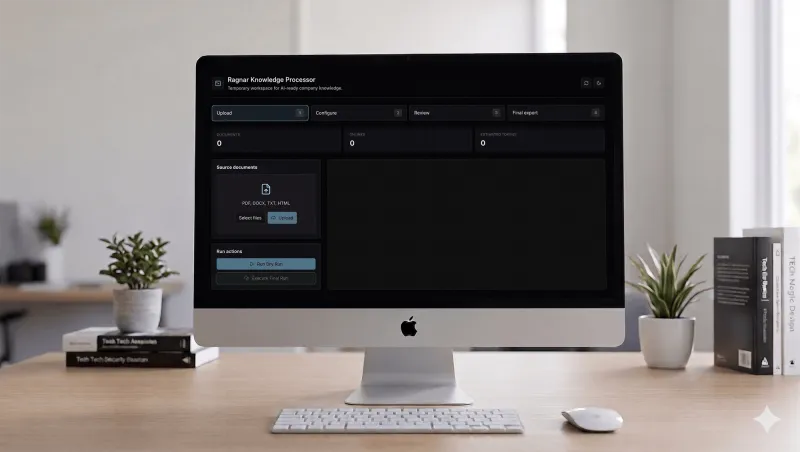
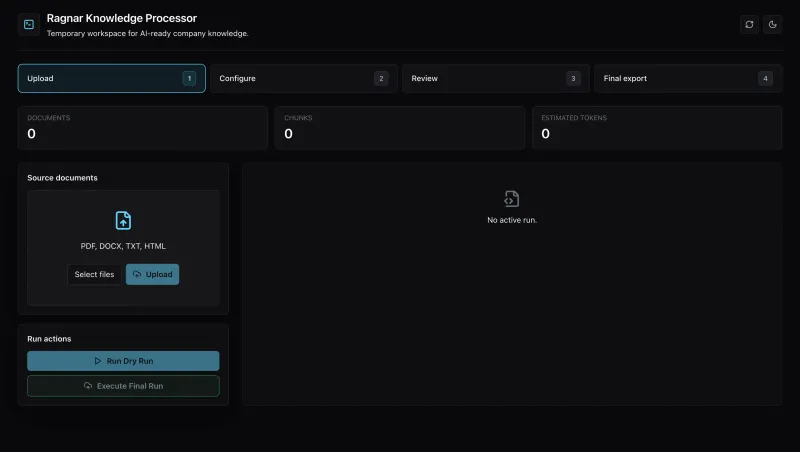
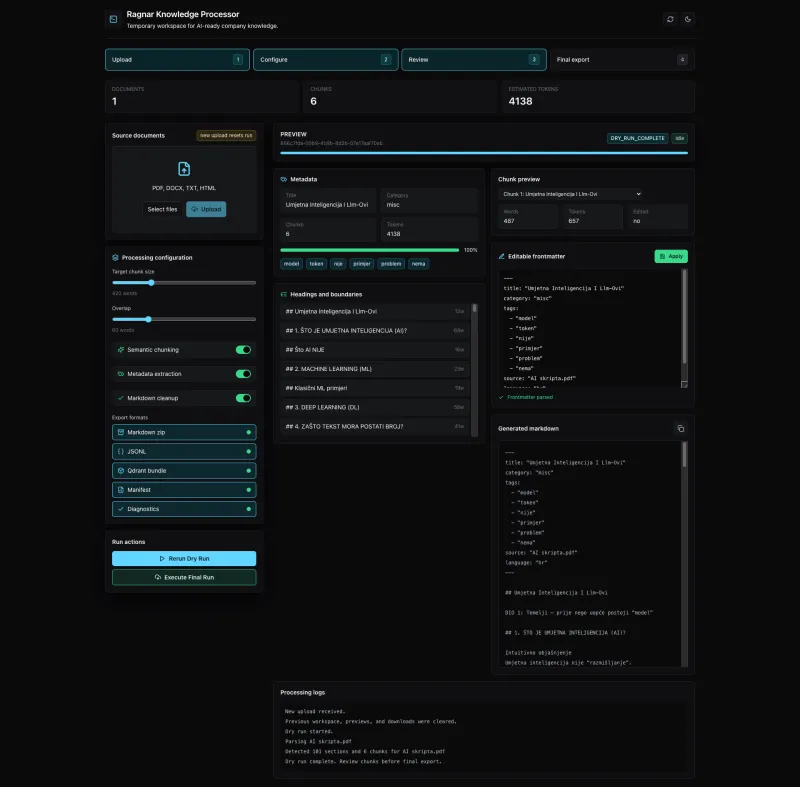
Two connected layers. RAGnar is a self-hosted local RAG platform for building assistants over private documentation. RAGnar Knowledge Processor is a Python preparation pipeline that cleans PDF and DOCX files, splits them by topic and saves them as small Markdown knowledge files.
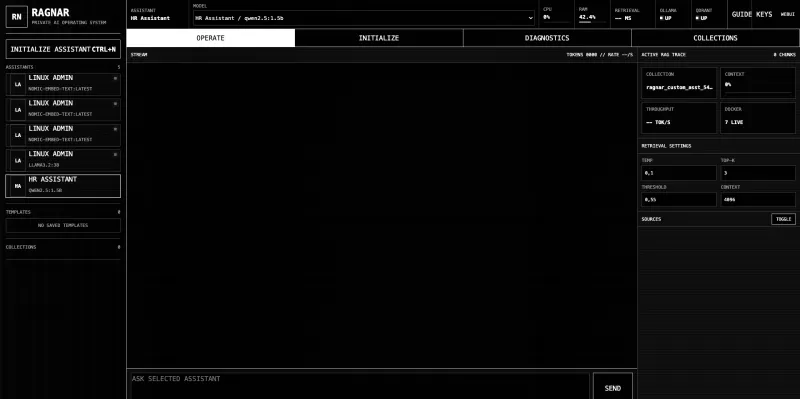
RAGnar lets you choose the model, configure retrieval, work with local embeddings and a Qdrant vector database, and display sources. The processor prepares the input so the assistant never has to work on large, noisy documents.
A Docker Compose environment. Open WebUI is the chat interface, Ollama runs local models, Qdrant is the vector store, FastAPI manages the RAGnar endpoints and configuration, and NGINX handles routing between the interface and the API.
The emphasis is transparency: the assistant should not only return an answer, it should show which document and which part of the text was used.
RAGnar is a base for several internal assistants: HR procedures, IT documentation, Linux guides, networking scripts, security policies or onboarding material. Instead of one general assistant, each can have its own documentation and retrieval settings.
The Knowledge Processor solves a step many AI projects skip: preparing knowledge before the chat. Smaller, cleaner Markdown sources give steadier retrieval, fewer hallucinations and clearer citations.
The biggest lesson was not that a bigger model is needed. It is that a better input is needed. Local models can be useful when documentation is well prepared, chunks are meaningful and the prompt is restrictive enough.
No single part is enough on its own. Infrastructure, the document pipeline, vector search, prompt rules, source citations and constant testing of answers have to work together.
Web and email requests enter one process, are classified by AI and end up as a clear ticket with routing logic and a signal to the team when a human decision is needed.
Describe where it breaks or what worries you, and what is already in place.
Pick up to three topics.
Ask something about the selected topics. Answers cite the notes they come from.
Answers come only from the selected topics. The bot can be wrong. Check the sources.
Conversations are logged for 30 days to improve the demo. Do not enter personal or confidential data. Messages are processed by an AI provider. Privacy